Resurrection
or the Modern Ship of Theseus
I shall die, and what I now feel be no longer felt. Soon these burning miseries will be extinct. I shall ascend my funeral pile triumphantly, and exult in the agony of the torturing flames. The light of that conflagration will fade away; my ashes will be swept into the sea by the winds. My spirit will sleep in peace; or if it thinks, it will not surely think thus. Farewell.1
You will rejoice to hear that today I am writing to you in order to let you know that I have been obsessed with this idea; resurrection. I am eternally inspired by Mary Shelley who created a monster out of neglect. Her story builds upon the fact that sometimes abandon alone creates a monster. The bodies that make the creature in the story are also off of those neglected; “I collected bones from charnel-houses and disturbed, with profane fingers, the secrets of the human frame” 2. I believe that the torment the creature faces his whole life is deeply connected to his uprootedness. He is in the border of life and death, human and creature, natural and synthetic. He feels joy of life as much as he feels abandon. I want to take this story as a road map to a method of care and maintenance.
I find myself researching death and afterlife and how we dispose of our dead; dead things, bodies, something we have created, or come to live with and later on neglected. To calm myself down and stop worrying about the repercussions of such neglect, 3 I'd like to think this is a mere 'parking' situation in some cases. However I know in my heart that this is departure and not one that I come back from. I feel like there is this layer of dust covering all my properties.
I will attempt to dive deeper into this idea of resurrection, because I would like for you to care as much as I do for this property issue. You see, when I try to move about in my life, I face this undeniable restraint. It disallows me from thinking freely or interacting with intention. I find myself rooted in vagueness, in ambiguity. I feel this need to settle reflected back at me everywhere I look. I see it on the mirror, in error codes on screens, in broken links, in inaccessible third-party resources, holes on the ground.
The need for resurrection I feel, is larger than an individual need. Looking at tech-dead, their discarding will reveal the holes in the global tech industry’s understanding of life. Determining what is deprecated is often not in user’s hands. It is up to the production companies to move the products faster and control their ecological, cultural, digital and social influences. These influences create the discard culture that is destroying our understanding of resources along with resources themselves, adding on to an industry of exploitation, of depredation of indigenous lands, and pollution. The speed of which the neglect takes place of care is creating a warped understanding of time as well as de-valueing technological devices, digital media/ums. I will later tell you about alternative understandings of past and future in context of resurrection to reiterate how emotional value can derail financial value systems. Resurrection is not only about death but it is about the wonder of life and things that border life.
I do believe that there is death of things. I know there is an afterlife of them as well. This must mean that there is a necromantic relation with which the living and the dead are connected to each other.4 This relationship allows us to practice resurrection. My aim is not to make empty promises but to ignite the spirit of maintaining with intention and care. With the touch of a hand, we can meddle with origins, reinstate value. I want to remind you, my dear, that there is collaboration in making, remaking, remixing. There are multiple origins to those which are repaired for there is no working without the help of another. My own uprooted state in the world encourages me to research the origins of others in a similar state not just out of curiosity but I have found through experiments with old devices, that it is thus how we create a deeper connection, an invisible network that does not severe this connection resurrected, but the history of the device and its new identity surpasses the resurrection. It becomes a part of life. Through remembering, noting, referencing and archiving we can practice the long term resurrection. This is a chosen connection we can then later name, decide and deal with its relation to publics through contracts (after the end of creation), warranties (promising future possibilities of maintenance), codes (conditions), protocols (instructions).5
I believe in a structured passing, one that completes a circle and does not leave us wondering what is up next, what is new.
Who could be interested in the fate of a murderer, but the hangman who would gain his fee?6
In the way we deal with disposal of bodies, devices, waste otherwise there are parallels of urgency, commodification, lack of rituals/rites. The commodification of burial is consistent in all fields of burials. For the living, rituals of burial are fenced in by governments which try to govern the body even in death. The commercial death creates an artificial urgency to 'get rid' of bodies. Within the flow of these commodified ways of discarding 7 we forget to tend to the dead. We stop rituals, prayers, thoughts, and in dreams their visions are forced upon us. An old device, that has been unused and shelved does not compare to a human body. However, there is humanity in it. I believe that there is a correlation in the artificial urgency of disposal and the decline of burial rituals. We interact with the dead less and less.
There is not much afterlife for devices that are cursed to become waste by predetermined 8 definitions. My theory is not one that claims all waste is reusable or should be revived somehow. Through archaeology of devices, we may come to research the reasons why they become obsolete. Understanding death can lead to understanding life. This new insight can ignite interest in something forgotten. Through sparking curiosity for the past, we can change the way we perceive what belongs to us now. We can claim it in its complete reality and create belongings instead of property.9
In the thin veil that surrounds us, there are documents to prove that we belong. These documents come in different times of the process of ‘being’. There are ends that create publics, like a publication which then interfaces other creatives with licenses. Warranties promise a safer future. Manuals create networks of users long after a device is deprecated. It contrasts how certain these documents become even though the borders are imaginary. And documents at the border of here and there are plenty, for me it has always been a very well known document; a passport. In the mirror I see my situation reflect on the world of waste and at the tip of my fingers I see another one, slowly fading away as I type words letter by letter, at the peck peck of my keyboard. 10
Please find below more letters where I will be addressing how Mary Shelley's Frankenstein as a guide to the method with which we can create a resurrection protocol, the legalities and contractual borders where we operate and how can we create our own or disregard them completely, and lastly how collaborating in creating life through resurrection will change its origins, history and future. Here’s to the living.
Chapter 1 - Bringing Dead Media Back to Life as Method
Dear Meliha,
With this letter, I want to apply my inspirations of necromancy
as a method of bringing life back to digital media/ums and devices.
Frankenstein’s core values create a framework in which I find
resurrection as a structure to defy unnatural neglect installed into us
by consumer capitalism. The aim of my writing is to prepare a bond
that can withstand being broken time and time again, a commitment
rooted in attachments.
Mary Shelley starts her story with understanding and seeing the background of the creator, how he was raised and what he had hoped for. There are reasons and opportunities that make him how he is. His relationship with property, how he sees himself in regard to others. In her writing, she constructs a relationship of abandonment. Abandonment itself is severe because of the nature of the binding.The creator and the creature are connected through a painful obsession, bodily scraps of othered people and utter rejection. Through countless hours of research, focus and experiments, Viktor Frankenstein creates something that he is no longer able to look at. He creates a boundary creature of agony and despair, some-thing that never belonged, doesn’t remember it’s organs and is immediately unloved.
Without a name or a home, the creature learns how to read, write, care and then understands neglect, hate, revenge. It is born to reclaim its person. A reversed process of creating life goes wrong, there is no naming something that consists of others or an origin. The creature is destined to despair and loneliness as there is no history or claim. The work of all the foreign organs, Viktor Frankenstein, the storm, they are all collaborating to create something they lack to respond to, which is a lack of responsibility.11
To Viktor Frankenstein, this experiment is something he owns. The property of him makes this vertical relationship of dominance and tries to rule over the body he created.12 But the body itself is not one. It is of tens. This detached body seeks belonging. Where does the body itself belong?
The migrant has lost the nation state. The refugee has lost their house. The trans person loses their body. They all cross that border. The border is part of them and cuts through them.13
Between the creatures body and the world there is a veil of vagueness, we cannot place him anywhere. This evokes speculation where we try to guess where it will be going or where it will end up. The connection between us is lost from the beginning, we fail to fill the correct information in the right form. Even this need to put things into place might point to the notion that belonging is presumed.
This is where I place the line between functioning/non-functioning, obsolete/contemporary. This is where waste/non-waste lay. World is overflown with dead tech to which resources were poured into andcoding languages were invented for. Resurrection as method depends on the research of these dead as much as the object itself. By way of deeper research of the elements that make the media, the media will be situated in its own context. It will create connections with the history of where it came from.
Two years ago, I picked apart a T65 rotary dial telephone with my friend Fred. We got the telephone from an old man in Alexander, Rotterdam. We dismantled the phone to its inner bits and pieces. We researched how to reprogram it to create an interactive recorder and receiver. It wasn’t until a year later when I wanted to use three T65’s to resurrect a Party Line14 I really got to know about the history of the telephone itself. I wanted to resurrect the party line instead of the telephones because upon my repairs, I realized there could be resurrection in the social connections we have left behind with the telephone. Even though, I do not think we should go back to having landline telephones and answering machines, I do think upon the resurrection process I found it more interesting to recreate the social networks that the device could provide.
The more I wanted to recreate the party line, the more I learned about the evolution of in-house telecommunication technologies. I researched how I can make these T65 telephones connect without a ready-built intercom system. I wanted to use very simple connections to demonstrate the simplicity of the telephony network. Eventually I visited the Houweling Telecom Museum in Rotterdam to see if they could help me with the circuit. Arnold, the head of volunteers, showed me their collection of intercom systems and one device that was made in 1920s that was essentially two telephones in separate wooden boxes connected together. It had the schema drawn inside its box. The person who made it donated it to the museum. It was made a little bit more than 100 years ago, in 1925.
Upon my first visit to the Houweling Telecom Museum, we had the pleasure to chat with 2 volunteers who both worked at PTT (Staatsbedrijf der Posterijen, Telegrafie en Telefonie)15.the first phones that were officially from PTT They were produced in Germany and shipped here. There was a factory in Berlin (of Siemens) at the time PTT started to provide telephone services to the entire country, that shipped a lot of the telephony equipment (mostly switches and terminals) to the Netherlands which became unavailable after the war started. They had to change production companies to Phillips (based in Eindhoven). They told me that they could differentiate the origins of devices by color because all Phillips equipment came in gray and Siemens used black in their designs.
After an extensive online and offline research, it felt like I already know what needs to be connected where; connect all receivers to each other and then to a battery, essentially this is how the ‘hacked’ telephone party line worked at first.16 I looked into different types of intercoms (PTT produced their original product called the Homevox)17 , apartment doorbells, push and talk devices, VoIP boxes, hotel intercom systems. Alas, I couldn’t find my initial sources that helped me understand the telephone network systems. Thankfully, this initiated a process of research that benefited the method greatly. I found myself hitting walls during and having to talk to many people to grasp the technology of a Party Line. What inspired me greatly was media archaeologist and english literature professor Lori Emerson’s book, Other Networks and an experimental telephony initiative from Portland, FUTEL.
Other Networks is a book about networks of all kinds, wired, wireless, imaginary, otherwise. Here, I read about Barbed Wire Telephone which used to be a common practice of using barbed wires as telephone wires that can connect neighborhoods together. From FUTEL, I learned that they resurrected the old phone booths throughout Portland to provide telephony service to those in need for any kind of communication. They release a record of public conversations, findings and noted every year as a zine titles “Party Line” and share them with the world through internet archive.18 These were inspirations for my initial network resurrection.So far for my initial experiments of the method, I tried researching and noting origins of the devices. I used my time of research to look into the social losses of the Party Line as well as learning more about the local telephony devices that disappeared. As an easier way to explain the instructions to use the party line, I decided to name the telephones; Shelley, Shirley and Sherry.
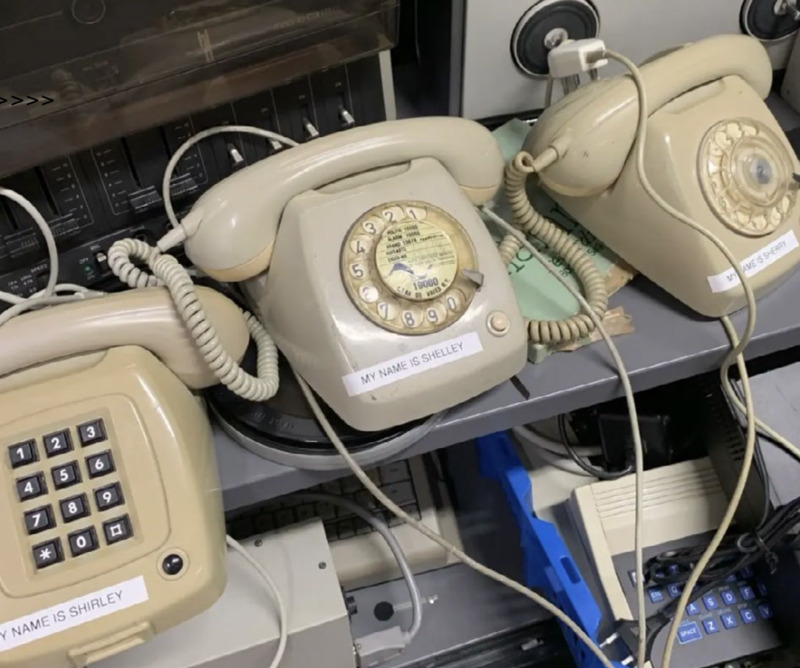
Clipping 1: Three T65’s called; Shirley, Shelley and Sherry sit on a shelf at the Experimental Publishing, Extra Magical Lab workspace.
I find it interesting to name something to form a connection to it. To get to know something we first ask its name. To refer to it we seek a definition and it starts with a name. Maybe this is how we bridge human language and language of things. 19
I believe that the research ignited by naming can continue by
researching other names. Were there other names for these devices,
hows does this name fit this device, why does this name make me feel
closer to it? Naming then allows building a sort of family tree of tech
devices in this sense. The family tree might reveal futures and ends of
productions, technologies and languages. It is not that we must look at
these as resurrected or focus on the reanimation of these dead mediums
as the end goal of the process. However, it is within the method to
Clipping 1: Three T65’s called; Shirley, Shelley and Sherry sit on a shelf at the
Experimental Publishing, Extra Magical Lab workspace.research into the ends of such
technologies and
coding languages to see
the reasons of their abandonment. This is to create a more sophisticated
understanding of the deprecation itself. In order to learn more about the
discarding we need to look into the methods of industrial reasoning of
discarding. Looking into these reasons will reveal the inner workings of
the necessary or unnecessary obsoletion and what we as users actually
want to keep.
Maybe BASIC* was the way to go...
Chapter 2 - legal frameworks and remixing
Dear Meliha,
As you know in my last letter I tried to draw you a picture of some
methods through which I believe the dead can be resurrected. The
resurrection requires always a form of collaboration with the object.
The archaeology starts physically from under the hood. With this letter,
I want to compare some of the contractual notions that affect properties
and future of properties, inheritances or legacies of them. As you know,
ownership comes with legal conditions and various claims having to
be agreed by the consumer. In being born, we find ourselves in various
already-belongings. We belong to this time and its opportunities and
failings. We belong to Earth and tend to it. Whatever comes out of
these relate back to us, we answer to them. This is why I believe it is
important to think about our belongings in an introspective way and
care for their relation to us through documents. There is a resemblance
of documentations and conditions of abandonment in different states
of belonging as well, such as documents of identity, rental agreements,
warranties.
As I am writing this letter, it is still March 2026. It will soon be April, then May. To me these are crucial months for my next residential visa. My permit of stay ends this June, right before I graduate. As my lawyer suggests, I must collect all the documents needed by April. But more about this later. Onto some lighter subjects...
When I was looking at documentations of T65, I stumbled upon a manual for the Homevox, the intercom system distributed by PTT. At the end there is a Terms of Service section which clearly instructs to calla repair service of PTT to come take a look at the system. It also clearly denies service in the box has been tinkered with in any way outside of PTT’s reach.20 There is also a copyright statement at the bottom that forbids this document to be copied or shared. I found the document on a website made by Jasper de Kat Angelino.* He shares his entire Dutch telephone collection and some of their manuals scanned by himself on this website. He is my collaborator.
In Frankenstein, this is something that really irks me. You see, the bodies sacrificed to this famous experiment of resurrection are never again mentioned. They have been nameless from the beginning. Their contribution is disregarded and their collaboration is assumed. But the abhorrence these bodies create refers to only Frankenstein as the father of this creature whereas the lineage of the body goes far beyond him. It is this generations of abandoned bodies, stolen right after their death creates the creature. Neglect is a collaboration.
I find myself feeling guilty about the neglect I personally contribute to the world of waste. Not through my own personal contribution to the waste pile, but becoming senseless to the habits of consumerism that are shoved down my throat. I find myself compliant and silent, feeling hopeless at times whereas I used to feel angry and reactive, taking initiative. As the borders tighten, I find myself in a corner, self- soothing. A part of resurrection is also reviving and remembering that power of self, the one that can come from within. The research and method is not only meant to widen our understandings of digital’s past but so we can stand up for our technological futures.
It is within my truth to live within collaborations of neglect. In my constant try to gather required documents for my visa, I find myself bound to too many governmental and financial ties. I feel ties to this country without the bureaucracy of the governed land. Environmental law lecturer and practicing lawyer Sarah Vanuxem 21 develops an ecological notion of property where she conceives all systems of property as a non dominated resource, somewhere one inhabits and tends to. The first chapter of this visa application was to prove mycontributions to my surroundings as an artist. How did I contribute and affect my community through my art? It was interesting to look at my milieu to see where I am situated within it. The next chapter was completely financial. How much do I contribute to the economy and can I sustain myself as a free agent of art in the country? Like many others, this financial restraints put me in a position of working at a job I didn’t particularly choose to work for at for years. These imaginary walls create docile creatures without professional boundaries, without voice.
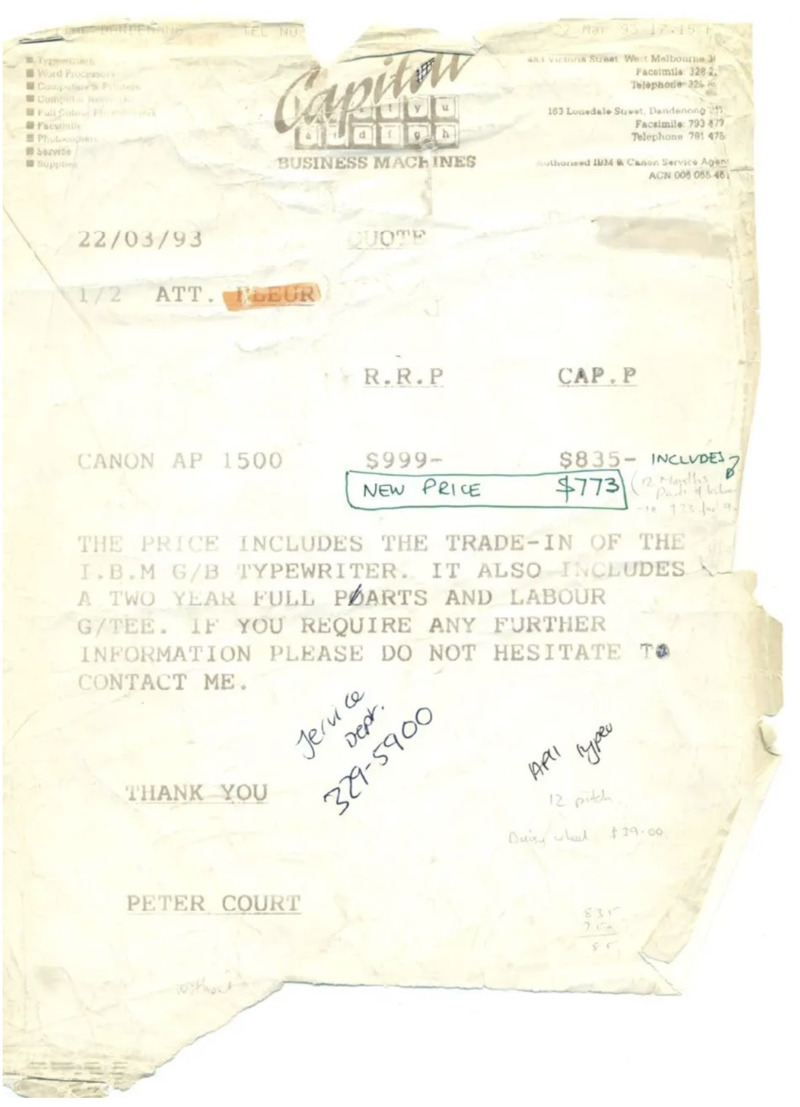
Clipping 2: A sales-invoice from 22 March 1993 that shows an exchange happened for the sale of a Canon AP 1500 tyepwriter. A I.B.M. G/B TYPEWRITER was traded in for discount. Found by Steve K (2022)
After thinking and filling out my own forms and documents, I find it interesting to look into the documents of the devices I have within my Clipping 2: A sales-invoice from 22 March 1993 that shows an exchange happened for the sale of a Canon AP 1500 tyepwriter. A I.B.M. G/B TYPEWRITER was traded in for discount. Found by Steve K (2022).possession. For them there are some other regulations of belonging.
It changes hands through purchase or barter. I have seen documents of exchange (see the clipping before), warranties and stern statements printed onto the shaft of devices. These usually postulate terms of repair in the warranty documents. The documents that reject third party repairs is a great example of a contract that induces disrepair. 22 Contracts of disrepair include restraining conditions of repairs, obsolete repair solutions 23 and contractors that expired their reach or where never within reach. These contract become more and more crucial in a world of precarious repair possibilities. The production is further away, the responsibility is further away and the lack of resources affect the availability of components.
In a ways contracts of collaboration are the opposite of contracts of disrepair. However, collaborations usually do not become contractual. They become a moment in time where connection happens without conditions. These can be called commitments or promises in legal terms, but they are not put on paper. There are some artistic examples of collaboration contracts like CC4R, CC2R and PAACT. 24 These contracts encourage working together or disassemble the notions of ownership as a creator all together. These documents declare clearly that there is collaboration in making.
They encourage it and endorse it. Doing so in contractual format draws attention to other contracts that disallow such working together conditions. These contracts are valuable to me in the sense that they defy belonging as a proprietors right. I don’t believe in the sole power of contracts, but in a world that does, it is important to reach out your fingers to try and mold the legalities that seem set in stone. Attached below is a clipping of a metal casing. That is the case that holds the tube monitor inside of a Northern Telecom Display Phone, dismantled by repairer and co-author of Open Circuits: The Inner Beauty of Electronic Components, Eric Schlaepfer.25
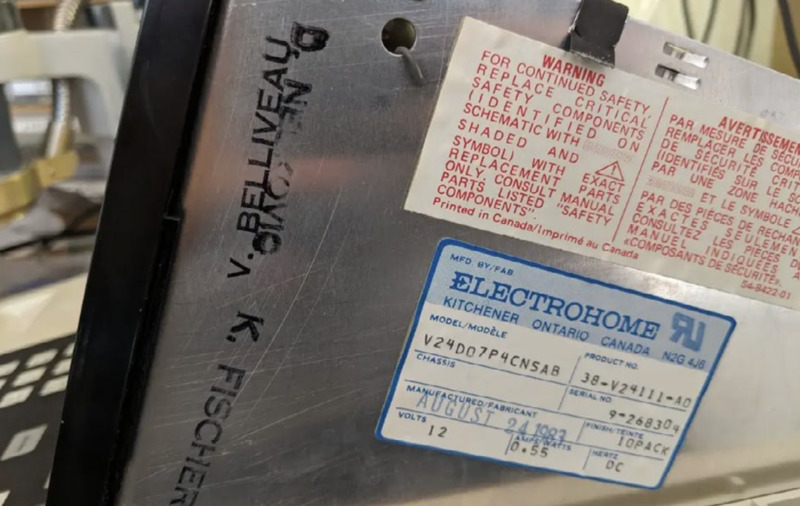
Clipping 3: Inside of a Northern Telecom Display Phone. Names read: V. Belliveau, K. Fischer, D. Nelkovic. (Schlaepfer, 2019)
The names on the display case indicate that the makers of this device
are not only credited but they are responsible for it.
In the mode of resurrection I’m dreaming of, I would prefer it to be so
that the origins include the repairer within contracts. The contractually
protected anti-repair technosphere should include collaborations of
people who work on the devices as a part of the terms and conditions. It is
easy to forget that a hand touched this device before it was functioning.
It is easier to remember this fact through examination of devices and
deconstruction of them. Like CC4R, owners can exercise experimental
licenses and contracts to practice the notion of collaboration through
repair. After all, repair is another addendum to parts already existed,
it implies and encourages remixes. Like many collaborations, repair
needs to have an understanding of two parties/realities, the old and
the new. The new needs to understand the old through interpretation
of the existing parts and functionalities. It is a hidden language of
assembly that reveals itself to the repairer. I believe that this contractual
agreement I wanted to implement would set terms of commitment
and refers to each collaborator like a family tree since we are all here
together. Time is neither linear nor cyclical in this framework as
both the past and present are resonant and relational. 26 Whence did
this device come from? What is its destination? These questions will
continually occur, sometimes without an answer. 27 This reminds me of
creative legal scholar, writer and judge Sarah Keenan’s conception of
Inside of a Northern Telecom Display Phone. Names read: V. Belliveau, K.
Fischer, D. Nelkovic. (Schlaepfer, 2019)property as a time based commitment. In her
book Subversive
Property,
Keenan touches upon temporality in this context as the repetition,
the habit, the accumulation of gestures that shapes the space such
that it is oriented towards particular objects or bodies. 28 Similarly in
Conversation Transcripts, professor, educator and researcher artist Eva
Weinmayr compares a contract to a license through time;
'A contract is negotiated at the beginning of a process,
whereas a license is attached at the end of the process.' 29
Even though there is no linearity or circularity to time in resurrection,
there is life and death. This transition of life is vague and it can be re-
animated. The legacies of the before life can be transferred on to the
afterlife and create inheritances.
In her essay Legal, Tender political theorist Angela Mitropoulos points that in financial inheritances, those who do not fit into the traditional family structure (queer people, people who choose their own families) create an alternative genealogy. 30 Their origins are in their hands, it is recreated and reborn as they make new kins. And this differentiation of origins affect inheritances, legacies, they subvert the monetary value system where the choice to be a part of a community is within legal limits. Through belonging to each other, they create legal ownerships. Just like Mitropoulos, Keenan too starts her book with a legal example of legal repercussions of queer identities. Keenan starts her belonging journey by explaining the case of Prossy Kakooza, a Ugandan woman who gained asylum status in the UK through a campaign. Her campaign was successful because it based Kakooza’s lesbian identity as a danger to herself in Uganda. The campaign was supported by Manchester Metropolitan Community Church. Keenan explains her issue with the campaign:
Never was there any mention, let alone discussion, of the politics of queer resistance in Uganda, the colonial history or the contemporary economic and political relationship between Britain and Uganda, the active role of conservative US Christian churches in promoting homophobia in Uganda,or of Uganda as Kakooza’s home – a home that, however tainted, was still the place where her friends, partner and family remained, along with her house, her things, her local store, her life up until the time she left. Anyone’s relationship with the place she has spent her life will be complicated, no matter how horrific that life had been up till then; and anyone’s relationship with a new place of residence far from her old will also be complicated, no matter how much easier particular aspects of life are there. Yet these messy connections were ignored. It seemed problematically simplistic to me to portray Uganda as simply a place of danger for Kakooza and all lesbians and gays, Britain as their ultimate place of safety and Kakooza as a woman saved by British law and a Christian church, and now able to move freely forward in her life. 31I believe that discussing origins when we are discussing collaboration and repair is important because of these sort of examples where the origins are reduced to one thing that is easy to understand or relate to. I do not believe that every thing is complex, but belonging is. My intention is to maybe not yet conclude with a certain agreement or a contract but to think of the possibilities, restrictions, ways of emancipation of warranties as borders of hardware and publics. Working with others is a delicate balance. Working with others from the past, we must make new licenses and write our own. We should explore this vague interfacing boundary to play with notions of legality that might one day be enforced.
Chapter 3, collaboration, ownership and embodiment
Dear Meliha,
I am writing to you again, about the purpose of these letters; the
connection they might create. I am interested in the literary network it
builds in between us. Last year for another experiment 32, I
was writing
a
list of speculative care-based occupations of the future where I includedLetter
Sender as one. I
described the Letter Sender’s task as:
Your future seems to be entangled with another, [...] Your
work will be working together. Your work will be each others
business. Your work will blossom and develop into years of
priceless correspondence. The proof of your work will be
displayed in museums and the care work you have done will
be replicated by many. Your ideas will flourish more and more
with each letter sent.
When Frankenstein leaves his creature behind, he also leaves him unattended to face the world. Later, the creature hides between walls of other families to learn about familiarity, love and life. It encounters people in public and pays for it. It faces those who hurt him and the one who abandoned him with no doubt. It learns from observing alone and feels good feelings of others instead of it’s own. Their happiness becomes his happiness which then encourages it to help them. It learns his first words from them: “I learned and applied the words, fire, milk, bread, and wood.” 33 These words represent what the family needs and talks about the most. This reminds me of a poem I once read by the poet and translator Anne Carson, from her book The Beauty of the Husband.
Demeter’s victory
over Hades
does not consist in her daughter’s arrival from down below,
it’s the world in bloom
cabbages lures lambs broom sex milk money!
These kill death.34
I guess we unite in killing death... The world in bloom which I find all to be parts of life that need a community; milk and the baby, money and the exchange, lure and the ears. It is no secret that community is needed for growing roots, but for last steps of this idea of resurrection community becomes crucial. This is where resurrection gets it’s power to influence from. Through creating a network of care, devices find irregular roots, find new collaborators, become parts of remixes forprojects and demonstrate possibilities of resurrection. After all, it is magical to see something dead come back to life.
As I explained in a previous letter, last year I resurrected a wired social network, the party line. To get to know this network and it’s local history, I talked to many people and visited thrift stores that still had relevant components to my telephones. This was eye opening to see what I needed for the process of resurrection, I needed people in places that supported, encouraged and enabled the idea. During the demonstration of the network, it also became clear that exposing the resurrected network to the public was another crucial part of the afterlife of the resurrection. Many people wondered how I connected the phones together and how did they actually work, why didn’t they ring, could they call anywhere else with them? These questions are what makes the repair successful, not the final status of the device. And so the resurrection circle includes, but is not limited to, the local repairers, local historians of networks from wired to wireless to imaginary, stores that still provide components, grassroots organizations that can facilitate conversations, and audiences. Local circles are important to the resurrection since they provide the safety net and the source of information to perform one. A great example of these circles and the need for them is that a lot of the web museums and archives I have visited online have a section of links. These links are usually to other enthusiasts or sometimes people they know in real life. A volunteer at Radio Museum Rotterdam tells us, these circles of enthusiasts all throughout the Netherlands were not only the reason the museum was founded but also they took the devices that needed to be handed over after the museum had to move to a different location. We connect all over the country and luckily locally. We show each other devices and technologies we find fun and interesting. We share our repair logs and schemas with each other. In this way DIY expands to DIT: Do It Together. Things break and it’s fun! 35
In all reality, I believe the way an abandoned device is already a collaboration not just the repair, resurrection parts. Their collective past and common destiny, their simultaneity in time bound all of usabandoned together. 36 The dead take the space with them, the space they were crafted at, the resources that allowed them to become. 37 These spaces that come from their past transform the community they find in their afterlife.
As parts of this method progresses, I find myself wondering about how feasible would this circle be to begin with? Would it be possible to maintain? Is there any other accommodating spaces in our vicinity that we are not aware of? Attempting to map these spaces of resurrection, I have compiled them on a virtual map with layers; Medical Assitance, Free Dinner, Places, Werkplaats, Museums and Supply Stores.
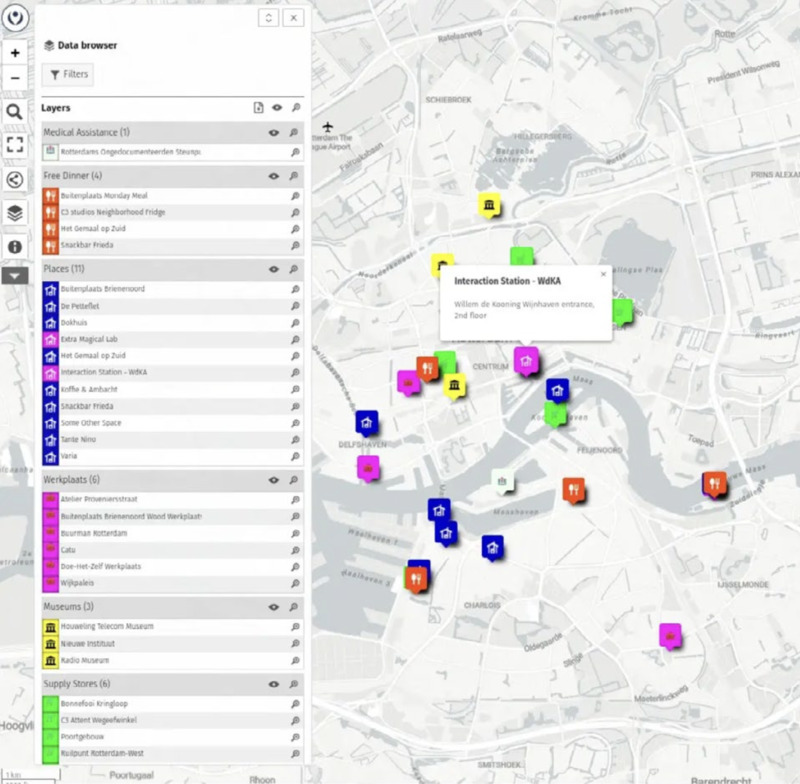
Custom map showing layers and spots above mentioned in Rotterdam.
This local resurrection circle is already alive. It operates within each other’s spaces and they are connected to each other in local zeitgeist. One place inspires another and we see their local collaboration in real time.
Custom map showing layers and spots above mentioned in Rotterdam.Well, I dream of a more interconnected circle. I imagine it having a meeting time an place where we hear each other’s stories and see each other’s repairs. I want to know how to fix a bike, how to fix a hole in my sock and how to repair a Phillips CM8833 Monitor. I would like to hear what others have to say about a device I find in the school or at the museum and what can they tell me about it.
Dear Meliha, as I am finishing up this letter I would like to say it is not a complete dream to have a distributed network of repairers that are in touch with their nearby community’s needs and wants. In Rotterdam, I can see that there is a great want for it. The affordances of care however make it trickier to create this environment of slowing down to look closer to a hole in a sock instead of buying a new one. One must have the time to be able to follow the rhythm of care.38 The affordances of care is what makes this possibility of a network even more precious. It is true that without a safety net, it is hard to become a caregiver to even more things in life. It is not a luxurious living to try to take care of and maintain others in your life. It is hard work and it is daily. Implementing more care work is not to make our lives harder or busier, but it is to make us more aware of what is going on with the politics of our belongings and how the politics of borders sneak into our everyday thinking. A hard plastic shell of a machine is a border protected by warranties that we can trespass and explore. It will not change the world of machines but it can make us individually understand the border/s better.Conclusion Sadly, this is my last letter to you. I want to conclude by reminding you what this journey has been about.
In finality, it feels like it is now my own self-inflicted mission to care. I am gladly becoming more and more of a person aligned with the notions I discover, the enthusiasts I meet, the devices I repair. I sometimes have this dream where I get on a bus and immediately start to think about what are the stops I need to make to get home. It gets exponentially hard to reach home the more I dream. The roads are familiar, but all the bus stops are mangled up in my mind. They are from all over the cities I’ve ever loved to live in. Ever since starting this research, I felt like I am going up a hill to only discover it was not one that needed to be climbed. However, I persist on my purpose; that there is a need for creating structures of care that surround the use and re- use of components we borrowed from the Earth, betraying the trust of belonging here, to revisit and resurrect old technological media/ums, devices and learn more about the histories of networks that made these inventions come to life.
The poet Melanie Hoff writes; It’s buttons all the way down, buttons pressing buttons. When I doubt my own thought this thinking really saves me from accepting everything as they are today, judging them only on their plastic cases. I strongly feel that every press of a key is making a press down to the history of the keyboard itself, the silent technology of the button, the position of it on the keyboard, systems that choose to operate on English as the main language of textual communication and the archaeology of language itself.
My proposal with these letters is to build an understanding of
interest, to create life; resurrection. I believe that thinking of devices
as living and accepting that there is a death of tech. Understanding
their afterlife, legacies and inheriting those values into new project,
new aspects can lead us out of the big tech enforced personal habits
of consumption. Although we must continue asking for contracts that
instate collaboration through repair, using the ways of resurrection
we can write our own contracts of belonging, defy temporal borders
which will reflect back on the defiance of other borders. There is radical
acceptance in living at the veil.
Sevgiler,
Sevgi
Footnotes
1 Shelley, 1818, p.351
2 When talking about his blinding obsession with his project Viktor Frankenstein reveals his crimes against bodies, only to succeed and create life, only to abandon it immediately after (Shelley, 1818, p.45). Frankenstein writes in his papers: ‘Hateful day when I received life!’ (Shelley, 1818, p.210).
3 Sharing similar concerns with professor Puig de la Bellacasa (2010) as she introduces her essay Matters of care in technoscience: Assembling neglected thing: “Our beautiful planet is sore, and bearable living conditions continue to be inaccessible to many. The joint fortune that all forms of life share with human technoscience is no longer news. Developing more scientific research and technological solutions continues to be the dominant response to problems, both globally and locally – whether they concern climate change, economic recession, hunger, infertility, access to healthcare or to information. Science and technology studies (STS) of all kinds thrive in this environment. From the everyday life corners of laboratories, households and gardens to the most arcane and techno-hyped spaces, our world has become a research space for network ethnographies and constructivist theories”
4 In Other Networks, media archeologist Lori Emerson lists necromancy as an Imaginary Network (2025).
5 Parse Journal’s Issue 21, The Ecologies of Dissemination (Ammonita et al., 2025), has a chapter called Conversation Transcripts in which Eva Weiynmar refers to contracts (to all contracts) as temporal, this is my attempt to try to imagine when in the process the contract comes to matter.
6 In a fever state Viktor Frankenstein starts to doubt every help he receives. His fears of encountering his creature effects his mind in cruel paranoia (Shelley, 1818, p.173).
7 In Discard Studies, Max Libroiron and Josh Lepawsky (2022) refer to the act of discarding as agreeing to a power structure: Classifying, defining, sorting, ranking things by value, and other forms of differentiation—creating and acting on difference—are central to discarding. These activities are not good or bad in themselves, nor are they merely technical. Defining things by one set of characteristics means other characteristics are not accounted for and become unimportant; ranking some things as valuable often devalues others. This means differentiation is almost always related to power structures. I find this as a really interesting part of waste, since it is in line with how I see the discarding of social bonds, real places, tech devices as similar to each other. This passage reiterates that the similarities are deeply instated in systems that control the borders of value.
8 As an example in Handreiking afvalstof of niet- afvalstof Versie 2.0 released by Ministerie van Infrastructuur en Waterstaat there are 3 conditions of waste: One must act on discarding it (there is action), one must intend to discard (there is intention), one must discard (there is legal obligation) (2026).
9 In Subversive Property, Sarah Keenan (2015) explains how properties within time become belongings and these belongings create relations within and without the limits of legality.
10 Gloria Evangelina Anzaldúa was a philosopher and poet ( September 26, 1942 – May 15, 2004), may she rest in peace. In her book Borderlands/La Mestiza she writes as if she was possessed by the spirits of borderlands, her poetry and her plain text is aligned within her true self; someone who was born and reborn at the border. Her borders become really muddy where reality and subconscience mind feedback and forth with each other. She writes: Sit between warmth and cold never knowing which is my territory, domesticated as I am by human warmth and the peck peck of my keyboard. Having lived my whole life in an ignorant shadow, under the sight of hunger shuffling its little child feet whimpering, lost. Pain is the way of life. Now I sense a warm breath on my face, see the shadow of a giant bird, her huge wings folding over me. Ella. (1987, p.95)
11 Anzaldúa (1987, p.20) talks about taking control back into her hands after feeling shut out of the either side of the border, her family won’t accept a lesbian rebel, Americans won’t accept her origins. She writes; The ability to respond is what is meant by responsibility, yet our cultures take away our ability to act- shackle us in the name of protection. Blocked, immobilized, we can’t move forward, can’t move backwards. That writhing serpent movement.,. the very movement of life, swifter than lightning, frozen.
12 Property lawyer Severine Dussolier explains in Conversation Transcripts that property may not be about owning in general where there is a vertical relationship of dominance but belonging (Ammonita et al., 2025).
13 Paul B. Preciado is a trans activist and writer who was invited to give a speech to Palais des congrès in Paris in 2019, where upon his first question was faced with laughter and mockery where he was forced out of. He couldn’t deliver his speech in its full extend and published it as a book in 2020. In his speech he refers to himself as the Monster created by the medical gaze, created within the contemporary psychoanalysts discourse as Another, a patient, someone who is mentally ill. Preciado (2020, p.40) declares: When you have cut down all the trees and mined all the mountains, when you have analysed all your dreams, there will be nothing left for you to break. The Earth then will be a rubbish dump, a vast trans body dismembered and devoured. The bodies of the colonists and your bodies, esteemed psychoanalysts, will be buried with the trans organs you have taken from us. But the organs that we do not have can never be buried. Our utopian organs will live on eternally. They will be the warriors storming the borders.
14 A Party Line is a wired network of more than 2 telephones, connected to each other that can withhold a conversation of multiple parties. There used to be advertisements for Party Lines to be used more often than normal telephone lines since they were cheaper to install and could connect short distances easily reestablishing already existing neighborhood relationships.
15 PTT used to be the public network service that was sold to KPN and privatized in 2013. One of the volunteer states that he has worked for PTT for 42 years, after PTT is sold to KPN he was and became a volunteer at the museum.
16 Emerson, 2025, p.94.
17 This was revealed to me while I was talking to the head of volunteers Arnold from the Houweling Telecom Museum. There are no dated record of this product online.
18 FUTEL doesn’t have an official introduction on their website but this statement: At Futel, we believe in the preservation of public telephone hardware as a means of providing access to the agora for everybody, and toward that goal we are privileged to provide free telephone calls, voicemail, and telephone- mediated services.19 Benjamin, 2004
*BASIC (Beginner's All-purpose Symbolic Instruction Code) is a programming language I encountered while I was looking through micro-computers in the Extra Magical Lab media library. It was designed as a 'simple' coding language in 1964. (BASIC, 1964)20 Statements can be found on Homevox 1-3 Homevox 1-5 Gebruikaanwijzing (No Date, p.45).
21 Ammonita et al., 2025 *Self proclaimed Dutch telephone enthusiast, updates and manages dutchtelephones.com.22. Merriem Webster re-defines neglect for their thesaurus dictionary as in disrepair the state of being unattended to or not cared for.
22 Merriem Webster re-defines neglect for their thesaurus dictionary as in disrepair the state of being unattended to or not cared for.
23 On page 44 of the official users guide of Homevox 1-3/1-5 PTT instructs: ‘If you have rented the Homevox from PTT Telecom or have taken out a service agreement for your Homevox, a technician will come to your home free of charge. Depending on the agreement concluded, the technician will arrive within 8 hours on working days (standard service) or within 4 hours (24-hour service). If the cause of the malfunction falls within the terms of the rental or service agreement, no costs will be charged.’
24 CC4R and CC2R (Collective Conditions of Reuse) are alternative contracts constructed by the non-profit research initiative Constant after a worksession titled ‘Unbound Libraries’ in 2020. CC2R and CC4R are two versions of the agreement, to invite others to play around with the ‘licensed’ work. It is a contract to subvert the idea of contractual restraints and language, to offer an invitation to collaborate instead of creating ownerships. PAACT is a working together contract written by an autonomous collective of co- creation Post-Collective. It touched upon the living conditions of the collective as a unit and individuals. It is a contract of collaboration that considers collectives as a unit and as individuals. It is made to be shared with others in order to create a better understanding of working conditions of artists who are refugees, asylum seekers, sans papiers and accomplices.
25 Eric Schlaepfer is a dedicated researcher and a media archeologist. He examines, fixes and documents his work thoroughly. He has a lot of social media accounts and a website, all under the nickname: TubeTime.
26 This is a direct quote from Making Kin with the Machines. By Jason Edward Lewis, Noelani Arista, Archer Pechawis, Suzanne Kite (2018). The article starts with the quote: Man is neither height nor centre of creation. Which I find relevant in terms of Frankenstein. The article researches ways in which Artificial Intelligence can be accommodated ethically as a kin of humans and how can we connect with an ethical sense of the technology through understanding languages that deal with multiplicity of kinship. I do not believe that there is a value in separating Artificial Intelligence than other technologies and in fact find it contradictory to research people’s connection with an extractive and invasive tool like AI. However, I find this study useful to look into making kin with technologies in general.
27 Shelley, 1818, p.189
28 After thinking about space as the main aspect of property laws, Keenan (2015, p.87) touches upon time as the tender of the space.
29 In Parse Journal Issue 21: Ecologies of Dissemination (2025), the chapter Conversation Transcripts is where Eva Weinmayr and Femke Snelting interview Séverine Dusollier on the aspects of copyright laws they are interested in. Femke Snelting is also a co-non-author of the aforementioned CC4R/CC2R.
30 Legal, Tender (2011) is an essay that dives into inheritance laws and legal structures of legacies through examples of governmental regulations towards queer people throughout different nations and histories. It is an example of transforming the idea of belonging from a financial and legal perspective through creating different origins and genealogies, which is one of the main inspirations I had for Frankenstein’s resurrection. I believe that the origins generated through the resurrection of the creature resembles of the repair process; researching origins, creating new ones, collaborating with the dead and through that creating different digital legacies and inheritances.
31 Keenan, 2015.
32 I am referring to Apollo’s Mouthpiece (2025) a project I made for Experimental Publishing Special Issue 27: See you many times! The project was a fortune telling performance where I controlled a human operated fortune teller and assigned care and maintenance related jobs to each participant. This allowed me to touch upon generating value through emotional investments rather than monetary ones which create their own sentimental economy.
33 Shelley, 1818, p.112.
34 Carson, 2001, p.42.
35 This is a modified quote from The Gender- changers manifesto (2009). Originally it goes; We dig deep into hardware and software to demystify them. We focus on free and open source software as a political decision. We share our technical skills in the same spirit. In this way, DIY expands into DIT: Do It Together. Things can break and it’s fun!
36 Pnina Werbner (3 December 1944 – 17 January 2023) was an urban anthropologist. She wrote; “Diasporas need to be grasped as deterritorialised imagined communities which conceive of themselves, despite their dispersal, as sharing a collective past and common destiny, and hence also a simultaneity in time.” (2002). Here my intention is to create the diasporic community of the dead tech in order to be able to talk about their relation to places (in the world), spaces (in local settings).
37 Sarah Keenan (2015) describes taking space as “[...] the idea that particular spaces are mobile in the sense that they stick to communities, individuals and perhaps even things and ideas.”
38 In the Feminist Hack Meetings/ Publishing (Decentralised Social Networks) chapter of the A Traversal Network of Feminist Servers, it is mentioned that they have chosen mailing lists as a tool that suggests different temporalities. These temporalities are meant to oppose the fast consumption of information faced in other of social networking tools. (2022) In this sense I find it interesting to think of the slowness of care-full consideration to capitalist consumption habits.
References
Anzaldúa, G. (1987). Borderlands/La frontera: The New Mestiza. San Francisco: Aunt Lute Books.Ammonita, E. , Cota, G.B. , Dusollier, S., Francke, A., Hall, G., Hayashida, J., Klasto. C., Mabaso, N., Malevé N.,Nguyen, C. T., Pierrot, P., Ranjan, R. K., Sekulić, D., Snelting, F., Soon, W.,de Valk, M and Weinmayr, E. & Wright, S. (2025). ‘Reuse Prompts’, in Parse Journal Issue 21 Ecologies of Dissemination. BASIC. (1964). Darthmouth College Computation Center. Available at: https://ghostarchive.org/archive/uOVBJ. (Accessed: 14 April 2026)
Benjamin, W. W. (2004) ‘On Language As Such’ in Bullock, M.,Jennings M. (ed.s) Walter Benjamin : Selected Writings. Vol. 1 1913- 1926. Cambridge, Mass. Belknap Press Of Harvard Univ. Press, pp. 62-75. K, Steve. (2022). Canon fodder (part six) E.T.ZONE. Available at: https://etzone.org/2018/04/18/canon-fodder-part-six (Accessed: 12 February 2026).
Carson, A. (2002). The Beauty of the Husband: A Fictional Essay in 29 Tangos. Vintage.
Franklin, U. (1990). The New World of Technology. CBC Enterprises.
Keenan, S. (2015). Subversive Property : Law and the Production of Spaces of Belonging. Abingdon, Oxon, Routledge.
Lewis, J.E., Arista, N., Pechawis, A. and Kite, S. (2018). Making Kin with the Machines. Journal of Design and Science.
Liboiron, Max, and Josh Lepawsky. (2022). DISCARD STUDIES : Wasting, Systems, and Power. S.L., Mit Press.
Ministerie van Infrastructuur en Waterstaat. (2026). Handreiking afvalstof of niet- afvalstof Versie 2.0. Available at: https:// afvalcirculair.nl/publish/pages/223176/handreiking-afvalstof-of-niet-afvalstof-2-0.pdf (Accessed 01 April 2026)
“Neglect”. (No Date). Merriam-Webster.com Thesaurus, Merriam-Webster, https://www.merriam-webster.com/thesaurus/neglect. Accessed 2 March 2026.
PTT Telecom. (No Date). Homevox 1-3, Homevox 1-5 Gebruikaanwijzing.
Preciado, P.B. (2021). Can The Monster Speak?. S.L.: Semiotext
Schlaepfer, E. (2019). Northern Telecom NT6K00AN DisplayPhone from 1982. Available at: https://x.com/TubeTimeUS/ status/1117548422469283841/photo/1 (Accessed: 20 June 2025).
Schlaepfer, E, Oskay W. (2022). Open Circuits: The Inner Beauty of Electronic Components. No Starch Press.
The Genderchangers Manifesto. (2009). Available at: https://web.archive.org/web/20090412200211/genderchangers.org/inc/index. php/Manifesto (Accessed 5 April 2026).
Werbner, P. (2002). “The Place Which Is Diaspora: Citizenship, Religion and Gender in the Making of Chaordic Transnationalism.” Journal of Ethnic and Migration Studies, vol. 28, no. 1, pp. 119–133. Accessed 1 April 2026.
Wynsberghe, Van W., Dobrițoiu, V., Săvoiu, T., Spideralex, Nisioi, S., Abbing, R. R., Hofmüller, R., ooooo, Bothof, N., Morandi, M., de Valk, M., Karagianni, M., Berends, M., Pereira, L., Bande, J., Snelting, F., Mugrefya, e., Portoghese, D., Tapia, D., Cochior, C., Cerezo, A., Mansoux, A., Gryllaki, A., Diakrousi, A., Bucur, A., pickles, a., Strete, A., Ștefănescu, A. A Traversal Network of Feminist Servers. (2022). Fractalia.